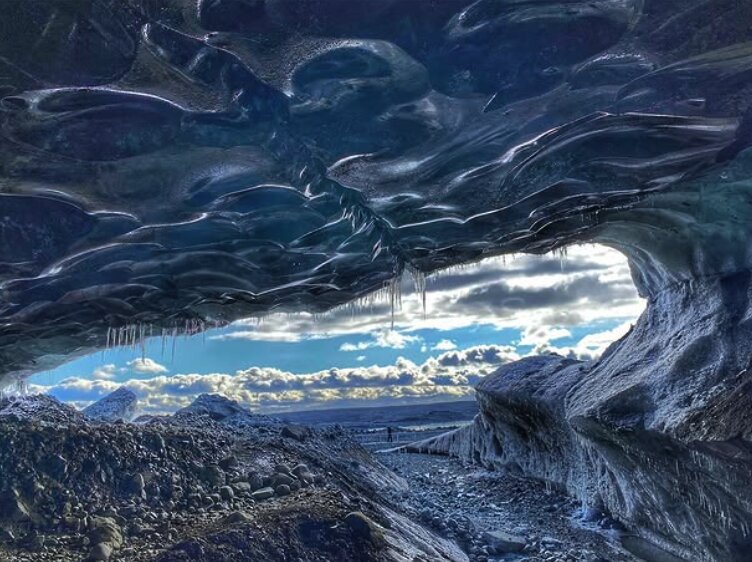
Do ice caves and northern lights overlap?
Yes, almost perfectly. Ice cave season runs roughly November to March; aurora season runs roughly September to April. The overlap is the entire natural cave season.
Better still, they do not compete for time. Cave tours run in daylight because guides need to see the ice, and the aurora needs full darkness. In midwinter Iceland has both in abundance: a short bright window for the cave, and a very long dark one for the sky.
The sweet spotFebruary and March. The caves are at their most reliable, the aurora window is still long, and daylight has recovered enough that a five-hour drive to Jökulsárlón is not done entirely in the dark. November is the close runner-up, with smaller groups and easier roads.
Is 2026 a good year for the northern lights?
Yes. Solar Cycle 25 peaked around late 2024 and substantially exceeded forecasts, and activity remains elevated through the declining phase into 2027.
The sun runs on an approximately eleven-year activity cycle. Cycle 25 began in December 2019 and was originally predicted to be weak, similar to the quiet cycle before it. It was not — smoothed sunspot numbers ran far above the initial forecast of around 115, and 2024 and 2025 produced aurora visible at unusually low latitudes.
The peak itself is now behind us, but the declining phase of a strong cycle is not a bad time to travel. Elevated geomagnetic activity is expected to persist through 2026 and into 2027, with the periods around the equinoxes — roughly March and September — historically favourable because of how Earth's magnetic field lines up with the solar wind.
A caveat worth taking seriouslySpace weather cannot be forecast reliably more than a few days ahead. Anyone promising you a good aurora night months in advance is guessing. Treat solar cycle information as background odds, not a booking guarantee.
Where to base yourself
Somewhere dark, and somewhere that is not a five-hour drive from your cave tour. Those two goals usually point to the same places.
Reykjavik is the worst aurora base in Iceland for the obvious reason — it is the only place in the country with serious light pollution — and it is also two to five hours from every ice cave. Basing on the South Coast solves both problems at once.
The whole of Iceland sits within the auroral oval, so you do not need to travel north. What you need is darkness and a gap in the cloud, and rural South Coast accommodation gives you both while putting a cave on your doorstep. See the Vík page for why it works so well as a base.
A realistic three-night plan
Book the cave early in the trip, keep the nights unscheduled, and treat the aurora as opportunistic rather than planned.
- Day 1: Drive Reykjavik to Vík with the South Coast waterfalls on the way. Aurora attempt after dark if the forecast is clear.
- Day 2: Katla ice cave in the morning, about three hours. Afternoon at Reynisfjara and Dýrhólaey. Second aurora attempt.
- Day 3: Either continue east toward Jökulsárlón for a crystal cave and the lagoon, or return west. Third aurora attempt.
Three nights gives three chances at a clear sky, which is roughly the minimum worth planning around. One night is a coin toss weighted against you.
How to actually check the forecast
Use the Icelandic Met Office aurora forecast for cloud cover and activity together. Cloud is what usually ruins an aurora night, not low solar activity.
- Aurora activity and cloud cover — vedur.is, the Icelandic Met Office
- Road conditions before any night drive — road.is
- The Kp index measures geomagnetic activity on a 0–9 scale; in Iceland even Kp 2 to 3 can produce a good display
The practical sequence is: check cloud first, activity second, then drive ten minutes away from any lights and give it an hour. Aurora rarely arrives on cue, and the displays that people remember often build slowly.
Should I book a northern lights tour as well?
Only if you are not driving. If you have a car and are staying rurally, you already have everything a tour provides except the guide's forecast reading.
Guided aurora hunts are genuinely useful from Reykjavik, where they drive you out of the light dome and know where the cloud is breaking. From Vík or Skaftafell with a rental car, you can step outside and look up. Money saved there is better spent on a small-group cave tour.
Photographing both in one trip
The gear overlaps almost completely: a fast lens, high ISO tolerance, warm gloves and a spare battery.
The difference is the tripod. Aurora photography effectively requires one, since exposures run from a couple of seconds upward. Inside a cave a tripod is usually impractical — the space is cramped, the group is moving and the floor is uneven ice. Take the tripod for the nights and accept hand-holding in the cave.
Cold and condensation are the shared enemy. Keep a spare battery somewhere warm, and put the camera in a closed bag before bringing it into a heated car or hotel, or the lens will fog. More on this in the gallery notes.
What can go wrong
- Cloud. By far the most common reason a trip sees no aurora. It is why multiple nights matter more than any forecast.
- Full moon. Washes out fainter displays. Not fatal, but a new moon is kinder.
- Booking the cave on your last day. Weather closes roads and caves; leave slack, and never schedule it before a flight.
- Expecting the photographs. Cameras gather light over seconds; eyes do not. A moderate aurora often looks grey-green and moving to the naked eye rather than vivid.