The short answer
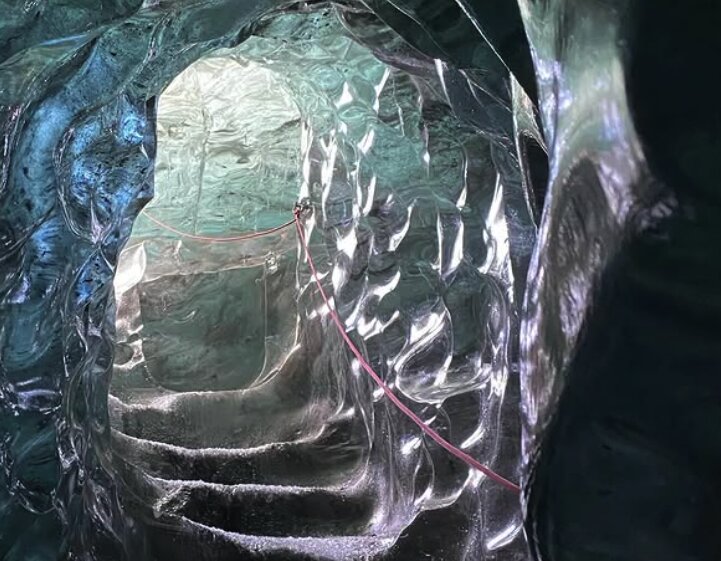
An ice cave is a void inside a moving glacier, carved by meltwater, and mostly seasonal. A lava tube is a hollow left in solid rock by a drained lava flow thousands of years ago, and open all year.
How a lava tube forms
A river of lava crusts over on the outside while still flowing inside. When the eruption stops, the molten core drains away and leaves a hollow tube.
It is the same principle as ice on a river, at about a thousand degrees. The surface of a lava flow cools against the air and hardens into a roof, insulating the lava beneath, which keeps running. When the supply is cut off, the remaining lava drains downhill and the tunnel is left behind.
Raufarhólshellir, the best-known example near Reykjavik, was formed in the Leitahraun eruption roughly 5,200 years ago. It is Iceland's fourth-longest lava tube at about 1,360 metres, reaching up to 10 metres high and 30 metres wide in places, with skylights where sections of roof have collapsed.
Which is more impressive?
Different, not ranked. Ice caves win on colour and rarity; lava tubes win on scale, permanence and reliability.
- Ice caves give you blue light, a sense of fragility and the knowledge that this specific cave will not exist next year.
- Lava tubes give you cathedral-scale space, mineral colour in the rock, and formations that have been sitting there since before the pyramids.
- Lava tubes in winter arguably give you both — ice stalagmites, frozen columns and ice curtains build up near the entrances from roughly November to April, with the most dramatic displays in the depths of winter.
When does a lava tube make more sense?
Whenever the ice caves are shut, when you are short on time, or when the weather has closed the South Coast.
The scheduling advantageLava tubes are the most weather-proof underground activity in Iceland. If your ice cave tour is cancelled by a storm — which happens regularly in winter — a lava tube near Reykjavik is the realistic same-week replacement, and it does not depend on a five-hour drive.
Iceland's main lava tubes
Raufarhólshellir is the one most visitors see, largely because of its proximity to the capital and the Golden Circle. It was closed in late 2016 so that accumulated rubbish could be cleared and a walkway and lighting installed, and reopened for guided tours the following year.
What it is like inside
Cool, dark, echoing and steady. Lava tube interiors hold a fairly constant temperature a few degrees above freezing regardless of the weather outside.
That means it can feel warmer than an ice cave in midwinter and considerably cooler than the air outside in July. Either way you want warm layers, and sturdy shoes with grip: the floor is rocky and uneven even where walkways have been built.
Helmets are provided and worn for a reason — ceilings vary in height and rock does come down. As with ice caves, entry is on guided tours rather than unaccompanied.
Can you do both in one trip?
Comfortably. They are in different places and different price brackets, and a lava tube fits into a half-day that an ice cave never could.
A common and sensible pattern is a lava tube on an arrival or departure day near Reykjavik, and an ice cave as the centrepiece of a South Coast leg. Because the tube is around thirty minutes from the city and tours run roughly hourly, it slots into gaps that nothing else fills.
If your dates fall outside the natural ice cave season, the strongest pairing is a lava tube plus the year-round Langjökull ice tunnel — one made by fire, one cut into ice, both open in July.
The honest comparison
If you can only do one and you are travelling in winter, do the ice cave. If you are travelling in summer, or your plans are fragile, do the lava tube.
Ice caves are genuinely rarer. There are lava tubes in Hawaii, the Canaries, Sicily and Korea; there are very few places on earth where you can walk into a blue chamber inside a glacier, and fewer every decade. But a cave you cannot reach because the road is shut is worth nothing, and a lava tube on a stormy Tuesday is worth a great deal.