How does an ice cave form?
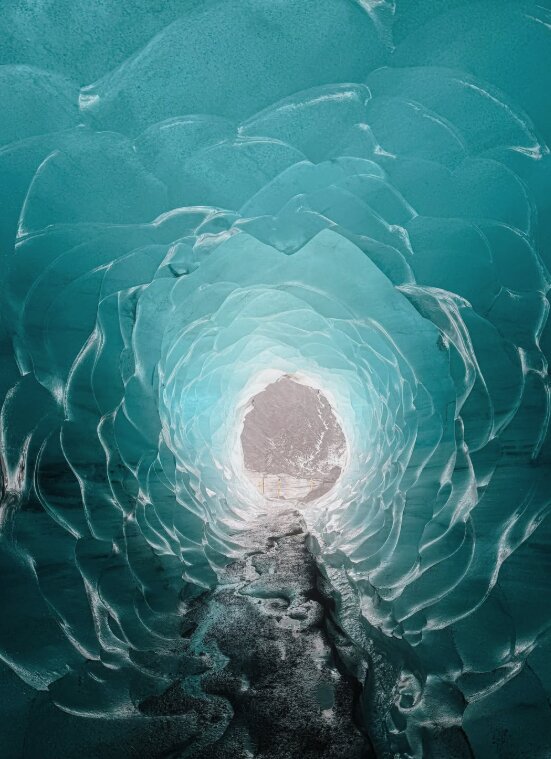
Meltwater carves it. Streams running through and under a glacier in summer hollow out tunnels; when the water drops away in autumn, the empty channel is left behind as a cave.
That is the whole mechanism, and it explains almost everything else about ice caves — their shape, their season, and why they cannot be relied on from one year to the next.
In summer, meltwater on the glacier surface finds a crack and pours downward. Over weeks it widens that route into a channel, using the same erosive force that carves rock canyons, only far faster because ice is soft by comparison. As autumn arrives and melting slows, the water supply dries up. The channel drains, and what is left is a void inside the ice.
Once winter cold has penetrated the glacier and stiffened the surrounding ice, that void becomes stable enough for a guide to walk a group into. It is a cave for one season only.
Why are the walls rippled and scalloped?
Because water shaped them. The curves and flutes on an ice cave wall are the fingerprint of the stream that carved the passage.
Those scallop patterns are formed by turbulent flow against the ice, and their size roughly tracks how fast the water was moving. Standing in a cave in January, you are standing in the dry bed of a river that ran hard the previous July.
Why are ice caves only open in winter?
Because they are only stable when the ice is cold. In warmer months meltwater returns to the channels and the roofs weaken, so operators close them.
Natural cave season in Iceland runs roughly from mid-autumn to early spring. Operators generally begin listing departures around November, some platforms cite mid-October for the Crystal Cave, and tours frequently run into early or mid-April before conditions end the season.
No operator publishes a fixed opening date, and that is not evasiveness. A cave is offered once guides have inspected it and judged it safe, and closed the moment that changes. A warm spell or heavy rain can flood a cave within hours in any month.
The exceptionsTwo ice caves in Iceland run year-round. The
Katla cave under Mýrdalsjökull is natural but sits in a stable enough position to be visited in July.
Into the Glacier on Langjökull is not natural at all — it is a tunnel bored into the ice cap and maintained, which is precisely why it never closes.
Why is every ice cave different?
Because each one is destroyed and remade annually. The cave that existed last winter has usually collapsed, drained or moved by the next.
Glaciers flow. Breiðamerkurjökull, which holds Iceland's best-known caves, is a river of ice moving downhill, and every void inside it is carried along, deformed and eventually crushed. Add a fresh melt season carving new channels and the result is a completely different set of caves each winter.
This is why guides do not promise a specific cave, why a photograph from a previous season is not a preview, and why the widely repeated complaint that a cave was smaller than expected is so common. Nobody is misleading you — the cave in the picture may genuinely no longer exist.
Why is glacier ice blue?
Because dense glacial ice absorbs red light and scatters blue. The more compressed and bubble-free the ice, the stronger the colour.
Fresh snow is white because it is full of air, and air scatters every wavelength equally. As snow is buried under successive years of snowfall, the weight squeezes the air out and recrystallises it into dense glacial ice. That dense ice absorbs the long wavelengths — reds and yellows — and lets the short blue wavelengths travel further and scatter back to your eye.
So blue is a direct signal of age and pressure. It is also why the colour is strongest in midwinter, when the ice is coldest and densest, and less reliable in spring when meltwater and warmer ice interfere.
Then why is so much of the ice black?
Volcanic ash. Iceland's glaciers sit on an active volcanic island, and eruptions lay down ash that later snowfall buries.
Decades later that ash reappears as dark bands running through the ice, effectively a geological calendar of past eruptions. The Katla cave is the clearest example, sitting directly on an active volcano, and its ice is streaked black and grey rather than blue. Even the famous crystal caves contain ash layers and sediment; clean uniform blue is the exception, not the rule.
What is the difference between an ice cave and a glacier cave?
Strictly, a glacier cave is a cave inside ice, and an ice cave is a rock cave containing year-round ice. In Icelandic tourism the two terms are used interchangeably for glacier caves.
Glaciologists make the distinction; operators, booking platforms and search engines do not. Everything sold in Iceland as an ice cave tour is a glacier cave — a void within moving ice. This site uses the common usage, because that is what people search for.
How are man-made ice tunnels different?
They are cut by machine into the ice cap and actively maintained, so they do not depend on meltwater or season.
Neither is better. A natural cave gives you something the glacier made and will destroy; a tunnel gives you certainty, in July, with children. The trade is authenticity against reliability.
What makes a cave safe or unsafe to enter?
Cold, and recent weather. Guides look at air temperature, rainfall, meltwater flow and fresh fracturing at the roof and entrance.
- Sustained cold stiffens the ice and holds the roof
- Rain or a warm spell can refill the channel within hours — the most common reason a cave closes at short notice
- Fresh cracking at the entrance or ceiling ends a cave's season immediately
- Glacier movement can deform a passage between one week and the next
When a cave fails that assessment, operators generally swap rather than cancel: the group is taken to another cave, an ice crevasse or a glacier walk. This is covered in more detail on the safety page.
Never enter one unguidedCaves that look solid from outside collapse without warning, and meltwater channels can fill in minutes. There is no walk-up access to any ice cave in Iceland, and the approach routes cross terrain where off-road driving is illegal.
Where the caves form in Iceland
Vatnajökull dominates because it is by far the largest ice mass, with the greatest volume of ice for caves to form within. More on each on the Crystal, Katla and Langjökull pages.
Sources- Vatnajökull National Park, Melting Glaciers
- Operator listings and season notes for the tours compared on this site, checked 22 July 2026